
Indexing in SEO is the process where a search engine stores and organizes a web page after it has been discovered and processed. A page can be crawled without being indexed and only indexed pages are eligible to appear in search results.
Think of indexing as adding a page to a massive searchable library where each page is categorized by topic, intent, quality signals and relationships to other pages. If a page is not in that library, it has no reliable path to visibility.
How Search Engines Move From Discovery to Indexing?
Search engines follow a pipeline that starts with discovering URLs, then fetching content, then understanding what it is about and finally storing it. Each stage has filters that can delay or block indexing.
This pipeline is not guaranteed or instantaneous, because search engines prioritize resources and protect index quality. Pages that look duplicative, thin, or inaccessible may be crawled but never stored.
Crawling Versus Indexing Versus Ranking
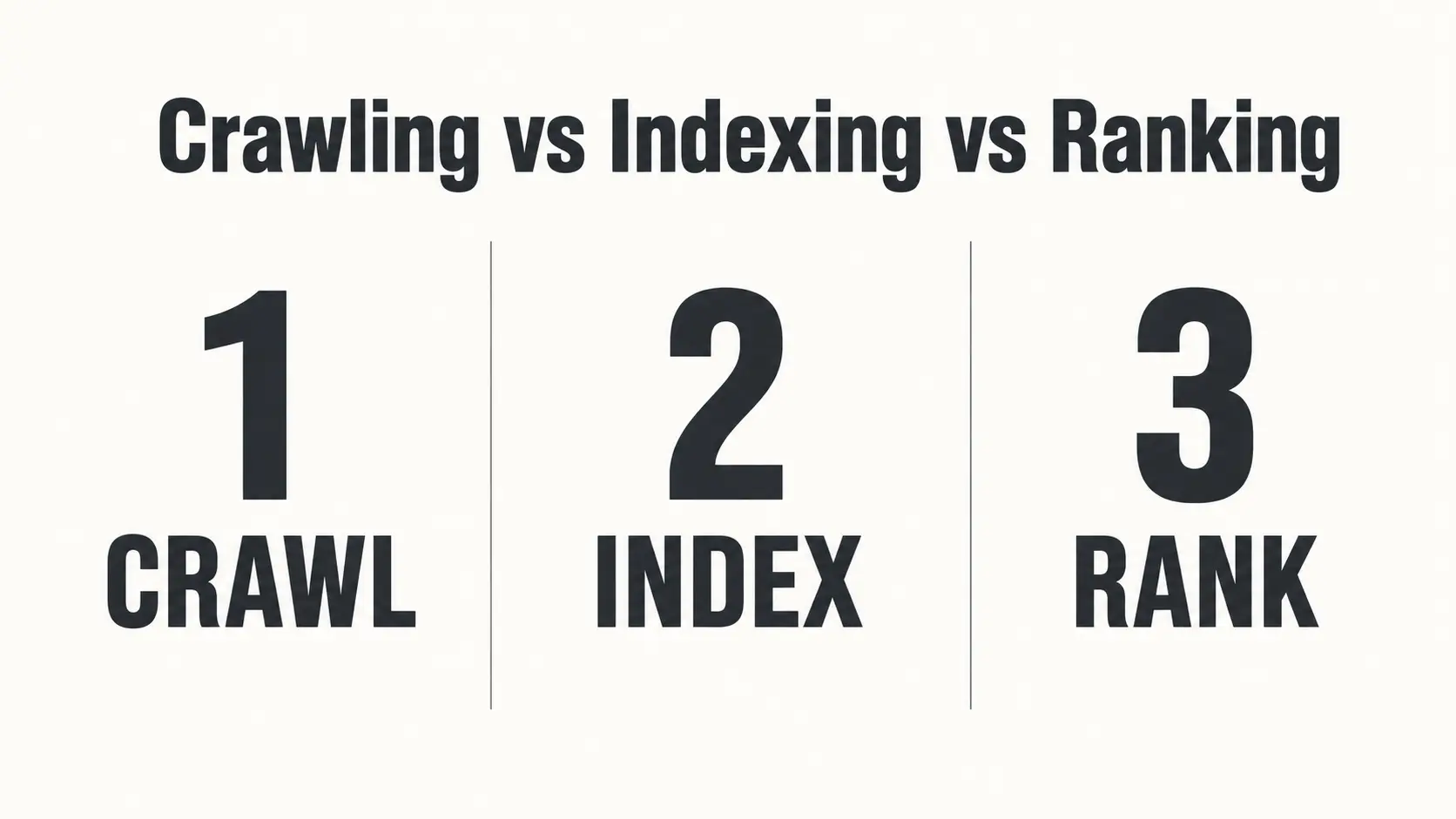
Crawling is when a bot requests a URL and reads its resources like HTML, CSS, JavaScript and images. Indexing happens after content is processed and selected for storage.
Ranking is the ordering of indexed pages for a query based on relevance, quality and many other signals. Confusing these terms leads to the wrong fixes, such as chasing rankings when a page is not even indexed.
| Stage | What Happens | Common Blockers |
|---|---|---|
| Discovery | Search engine learns a URL from links, sitemaps, or feeds | No internal links, missing sitemap coverage |
| Crawling | Bot fetches the page and key resources | Robots rules, server errors, slow responses |
| Indexing | Content is parsed, evaluated and stored in the index | Duplicate signals, canonical conflicts, low value content |
| Ranking | Indexed pages compete for positions on specific queries | Weak relevance, poor content depth, weak link context |
This separation helps diagnose issues quickly, because each stage has different causes and remedies. It also clarifies why technical fixes alone do not guarantee rankings.
Why Indexing Matters For Organic Search?
Indexing is the gateway to organic traffic because an unindexed page cannot consistently show for queries. Even strong content and backlinks will not help if search engines decide not to store the page.
Indexing also affects how quickly updates are reflected in results, which matters for accuracy, compliance pages, pricing and time-sensitive content. The faster search engines reprocess a page, the faster improvements can influence visibility.
What Search Engines Evaluate Before Indexing?
Index selection is a quality control step, not a simple data storage action. Search engines evaluate whether a page adds unique value compared to what is already known and whether it can be reliably rendered and understood.
Key evaluation areas include content quality, duplication, intent match, accessibility and the signals that establish trust. These signals come from both the page itself and its context across the site and web.
Content Quality and Usefulness Signals
Pages that demonstrate clear purpose, complete coverage and original insight are more likely to be indexed. Weak pages that repeat the same points across many URLs can be devalued during index selection.
Helpful content signals are strengthened by clear structure, descriptive headings, meaningful internal links and a lack of distracting elements. Strong topical focus supports better understanding during processing.
Duplicate Content and Canonical Signals
Search engines try to pick a primary version of similar pages to keep the index clean. If multiple URLs are near-identical, many can be excluded even if they are crawlable.
Canonical tags, internal linking and consistent URL patterns help indicate the preferred version. Conflicts between canonicals, redirects and sitemaps can slow indexing or cause the wrong URL to be stored.
Rendering and JavaScript Dependencies
When content relies heavily on client-side rendering, bots may need extra processing before they can see the main text. That extra cost can delay indexing, especially if essential content appears only after scripts execute.
Server-rendered HTML, clean structured layout and avoiding blocked resources improve reliability. If key assets are blocked, the page can be indexed with missing content, or not indexed at all.
Common Reasons Pages do Not Get Indexed
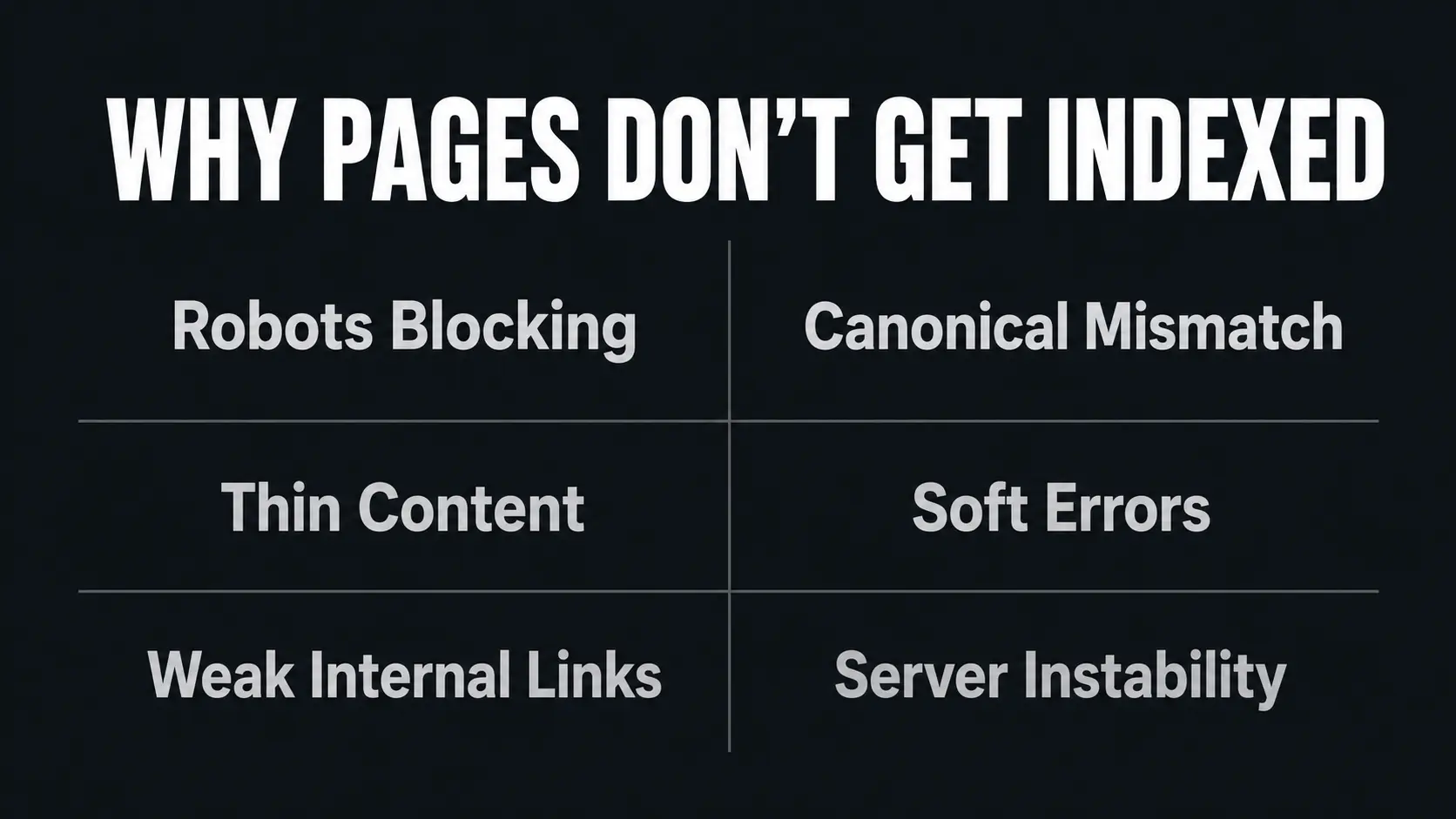
Indexing problems usually come from technical barriers, unclear signals, or low perceived value. Fixing the right cause is more effective than repeatedly requesting indexing.
- Robots blocking. A disallow rule or noindex directive can prevent storage even if the page loads normally.
- Canonical mismatch. The canonical points elsewhere, or multiple canonicals create conflicting signals.
- Duplicate or thin pages. Similar templates with minimal unique content often fail index selection.
- Soft errors. Pages that return a 200 status but show error-like content can be excluded.
- Weak internal discovery. Orphan pages with few internal links may not be revisited often.
- Server instability. Frequent timeouts, 5xx errors, or aggressive rate limiting can reduce crawl and indexing.
Once these issues are addressed, indexing becomes more predictable and less dependent on manual interventions. The next priority is making signals consistent across templates.
How to Improve Indexing Without Manipulation?
The goal is to make pages easy to discover, easy to fetch and clearly worth storing. That requires technical hygiene, consistent site architecture and content that stands apart from similar URLs.
- Make important URLs discoverable. Strengthen internal links from relevant hub pages and keep navigation consistent across the site.
- Submit a clean XML sitemap. Include only indexable URLs, keep lastmod accurate and remove redirected or canonicalized variants.
- Ensure correct indexing directives. Use noindex only when intended and confirm robots rules do not block required resources.
- Fix canonical and redirect chains. Keep a single preferred URL per page and avoid multi-hop redirects that waste crawl budget.
- Improve content uniqueness. Consolidate overlapping pages and expand sections that are too similar across templates.
- Stabilize performance. Reduce server errors, improve time to first byte and prevent intermittent failures that discourage recrawls.
These actions help search engines allocate crawling and indexing resources more confidently. They also reduce the risk of accidental deindexing when the site changes.
Indexing and Site Architecture
Site structure influences which pages are discovered early and which receive frequent recrawls. Clear hierarchies and topical clusters help bots understand relationships and importance.
Use a hub-and-spoke model where category or pillar pages link to detailed subpages and subpages link back to the hub. This improves contextual signals and reduces orphan content.
Indexing and Internal Linking Signals
Internal links act as discovery paths and also provide semantic context through anchor text and surrounding copy. Pages linked from prominent sections often receive faster attention.
Focus internal links on relevance, not volume and avoid sitewide blocks that flood bots with low-value URLs. A smaller set of strong links often outperforms a large set of weak ones.
Indexing and Technical SEO Essentials
Technical SEO supports indexing by making pages accessible, consistent and easy to interpret. Clean status codes, stable rendering and predictable URL behavior all reduce ambiguity.
Core essentials include correct HTTP responses, secure delivery, proper pagination handling and avoiding parameters that create endless URL variants. When the same content can be reached through many URLs, index selection becomes harder.
Indexing and Structured Data
Structured data helps search engines understand entities, relationships and page intent. It does not guarantee indexing, but it can reduce misunderstandings during processing.
Use structured data only when it accurately matches visible content and keep it consistent across templates. Markup that conflicts with on-page information can erode trust signals.
How to Monitor Indexing Health
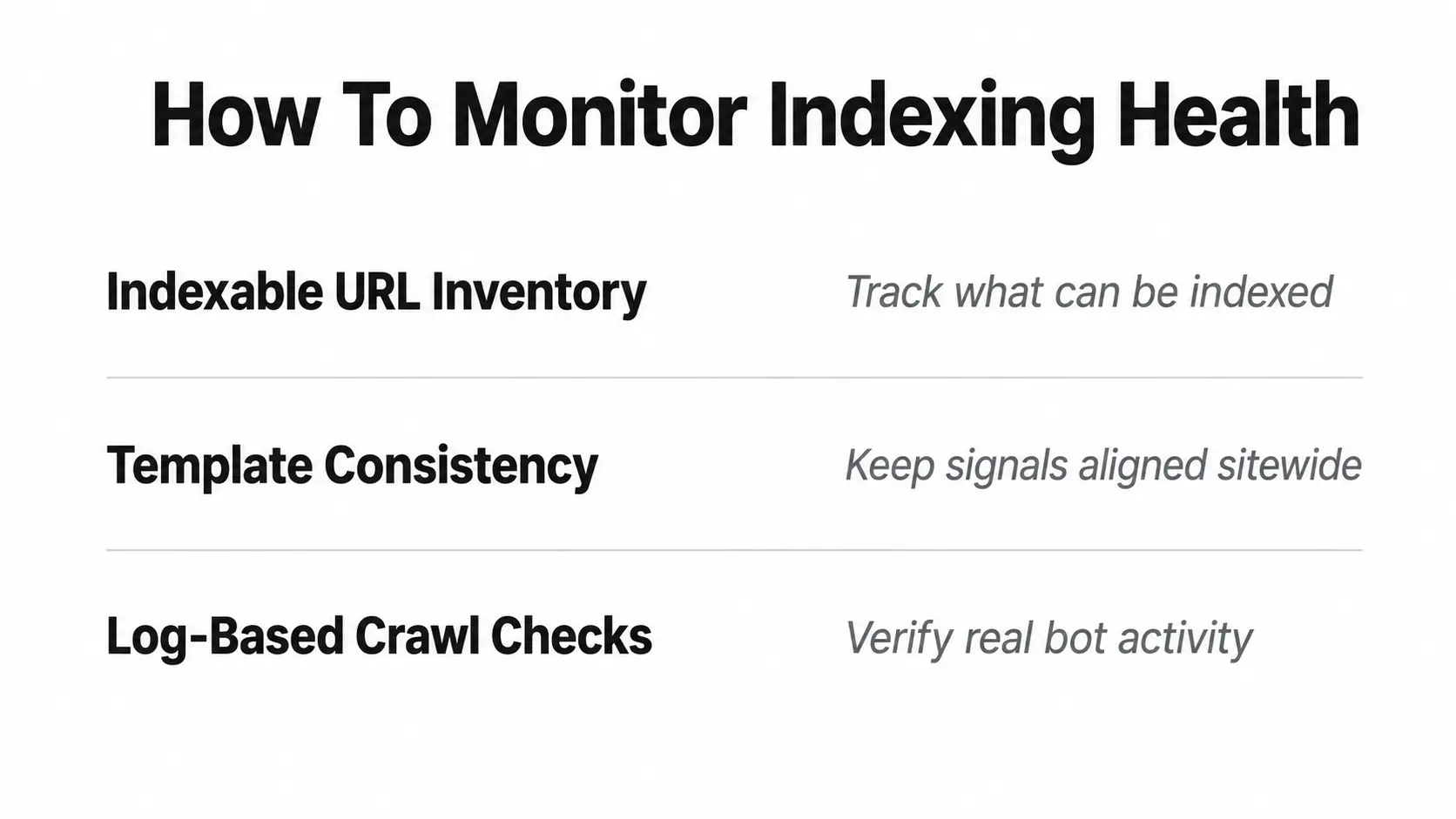
Indexing health is best tracked through coverage trends, server logs and changes in impressions. Watching patterns over time is more reliable than checking a single URL once.
Key indicators include how many submitted URLs are indexed, whether important pages are excluded and whether crawl activity aligns with business priorities. Sudden drops often point to directives, template changes, or widespread duplication.
- Indexable URL inventory. Maintain a list of pages that should be indexed and audit it after releases.
- Template consistency. Confirm canonicals, metadata and headings remain stable across page types.
- Log-based crawl checks. Verify bots are hitting key sections regularly and not wasting time on parameter spam.
Monitoring becomes easier when the site has clear rules for what should and should not be indexable. That clarity prevents accidental bloat.
Index Bloat and Why it Hurts
Index bloat happens when a site exposes large numbers of low-value or duplicate URLs. This can dilute internal signals and waste crawl resources on pages that do not help users.
Reducing bloat often improves overall efficiency, because bots spend more time on important pages and updates are processed faster. It also lowers the risk of low-quality sections shaping how the domain is evaluated.
Conclusion
Indexing in SEO determines whether your pages are stored and eligible to appear in search results. Strong indexing comes from clear discovery paths, stable technical signals and content that earns its place in the index.
Focus on removing blockers, consolidating duplicates and reinforcing site structure through relevant internal links. When indexing is predictable, ranking work becomes more measurable and far less frustrating.